Newsletter
Welcome! Every month Lancaster Emergency Management Agency features preparedness information, safety campaigns and training opportunities. In addition to the monthly newsletter there are featured newsletters highlighting seasonal preparedness information, volunteer opportunities and additional highlighted information. Sign up today to receive monthly newsletter via email!
June Preparedness Newsletter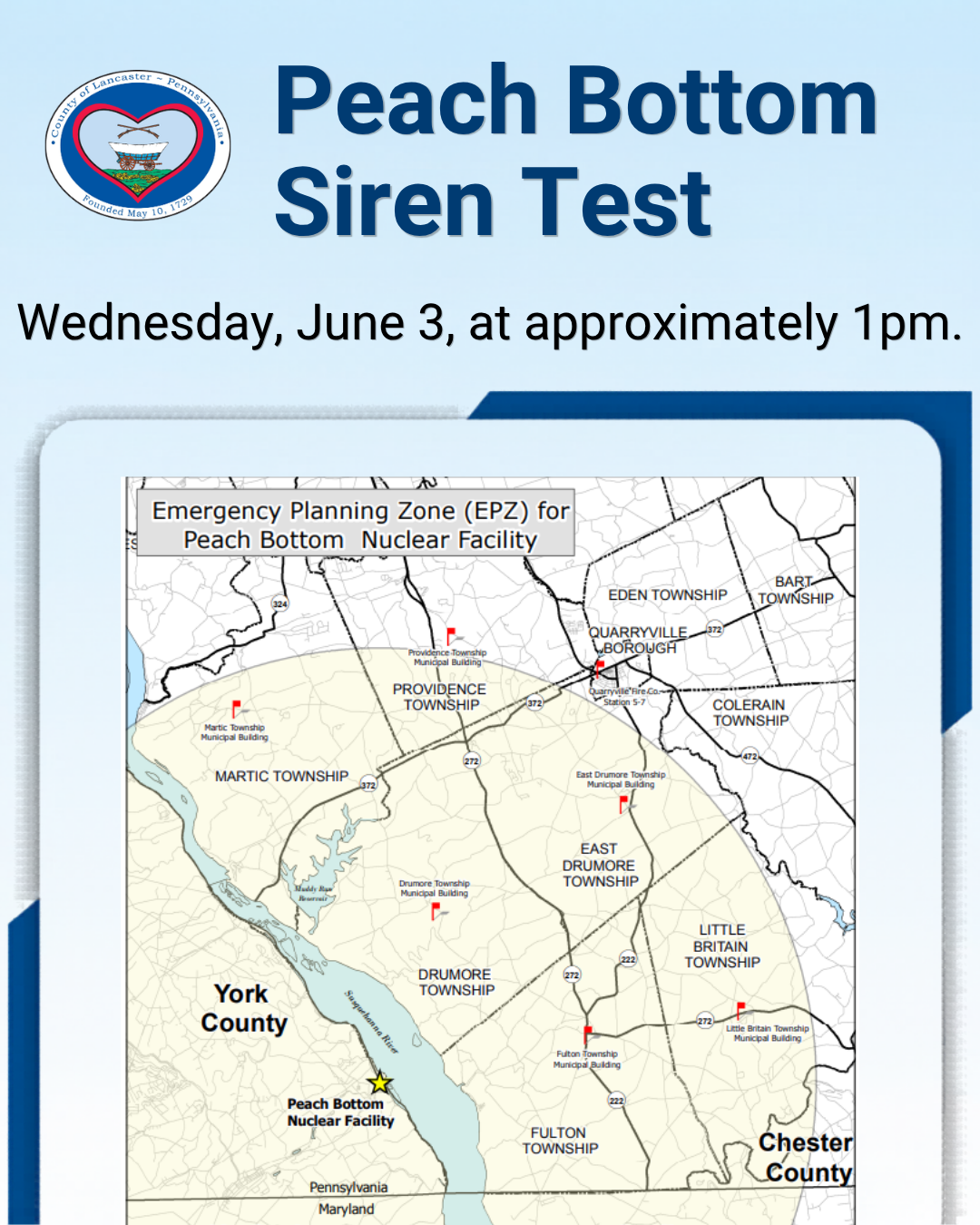
The June Preparedness Newsletter will cover a variety of topics including summer weather related safety, firework safety, emergency alert tests, and more.
Peach Bottom Siren Test
June 3, 2026
DELTA, PA- Constellation will conduct its semi-annual, full-volume test of the emergency warning sirens surrounding Peach Bottom Clean Energy Center on Wednesday, June 3rd at approximately 1 p.m. This is one of two semi-annual tests performed each year.
The warning siren system consists of 97 sirens located in the 10-mile radius around Peach Bottom Clean Energy Center. The sirens are not a signal to evacuate, but a warning to tune to a local Emergency Alert Broadcast television or radio station.
Peach Bottom Clean Energy Center is located on the bank of Conowingo Pond in York County, Pa.
Training Opportunities
AWR330: Whole Community Emergency Management Planning
Through guided discussions, individual and group activities, the AWR-330 Whole Community Emergency Management Planning Course helps participants identify and better understand the stakeholders and resources within their communities. Students will learn to develop strategies to better incorporate stakeholders into their emergency planning process, with a goal of increasing individual, community, and national resilience to all hazards.
When: June 9, 2026, from 9am-4pm
Where: 101 Champ Blvd Manheim PA 17545
MGT312: Senior Officials Workshop for All-Hazards Preparedness
This workshop provides an interactive forum to better understand the roles and responsibilities of community leaders as related to all-hazard disaster preparedness, to share proven strategies and best practices, and to enhance coordination among whole of community partners. Participants will be introduced to a basic understanding of planning operational coordination and public information and warning through lecture and group discussions. The participant will have the opportunity to work through a customized tabletop exercise focused on the strategic objectives faced by senior leaders. The final activity of the class is the development of an action plan to improve the preparedness posture of the community/organization.
When: June 10, 2026, from 9am-1pm
Where: 101 Champ Blvd Manheim PA 17545
National Lightning Safety Awareness Week
June 21 through June 27, 2026.
The best way for you to protect yourself from lightning is to avoid the threat. You simply don’t want to be caught outside in a storm. Be prepared by checking the weather before heading out and sign up for weather alerts. Sign up today for LANC ALERT!
If a safe location is not nearby you can:
- Avoid open fields, the top of a hill or a ridge top.
- Stay away from tall, isolated trees or other tall objects. If you are in a forest, stay near a lower stand of trees.
- If you are in a group, spread out to avoid the current traveling between group members.
- If you are camping in an open area, set up camp in a valley, ravine or other low area. Remember, a tent offers NO protection from lighting.
- Stay away from water, wet items, such as ropes, and metal objects, such as fences and poles. Water and metal do not attract lightning, but they are excellent conductors of electricity. The current from a lightning flash will easily travel for long distances
Although most lightning occurs in the summer, people can be struck at any time of year. Lightning kills an average of 20 people in the U.S. each year & injures hundred more. Stay safe with these tips. Learn more by clicking the image below or copy & paste the following link: weather.gov.gov/safety/lightning
Firework Safety
Summer celebrations see an increase in the use of fireworks. Each July 4th, thousands of people, most often children and teens, are injured while using consumer fireworks. Despite the dangers of fireworks, few people understand the associated risks - devastating burns, other injuries, fires, and even death. The best way to protect their families is not to use fireworks at home. The U.S. Fire Administration recommends attending public displays and leaving the lighting of fireworks to the professionals.
The Pennsylvania Office of the State Fire Commissioner emphasizes that fireworks injuries are largely preventable and urges Pennsylvanians to follow these safety guidelines:
- Avoid alcohol and drugs: Never use fireworks after consuming alcohol, illegal drugs, or medications that can impair judgment.
- Supervise children: Never allow young children to handle fireworks. Sparklers, which burn at 2,000°F, are the second leading cause of fireworks-related ER visits.
- Prepare for emergencies: Keep a bucket of water, hose, or fire extinguisher nearby when setting off fireworks.
- Use protective gear: Wear safety glasses to protect your eyes.
- Handle fireworks properly: Never hold fireworks in your hand or place any part of your body over them.
- Maintain a safe distance: Never light fireworks inside, near people, or near buildings.
- Dispose of fireworks safely: Soak spent and unused fireworks in water for a few hours before discarding them.
- Keep pets safe: Keep pets indoors, close curtains or blinds, and provide background noise to reduce stress.
- Stay legal: Illegal fireworks should never be used.
Summer and Extreme Heat Safety
Summer is just around the corner, bringing longer days, sunshine, and the potential for dangerous heat in Lancaster County. Extreme heat has the potential to impact anyone, but younger children, the elderly, and those with chronic illnesses are more vulnerable. Take a moment to prepare for the heat, so that it does not become a risk to yourself or your loved ones.
According to the Centers for Disease Control and Prevention (CDC), more than 600 people in the United States die as a result of extreme heat. Heat exhaustion, heat stroke and other heat related illnesses creep up on you quickly and become a life-threatening risk if you don’t take proper precautions.
You can stay safe from the risks of the summer, and beat the heat by:
- Staying Informed - Monitor the weather forecast and sign up for LANC-Alert to receive emergency notifications.
- Hydrate Often - Drink plenty of water throughout the day. Even if you are not thirsty, it doesn’t hurt to drink more water. Keep in mind, sugar, caffeine and alcohol dehydrate your body quickly!
- Stay Cool - Take some time out of the day to spend time in air conditioning or shaded places. You can go to a library, shopping center, or public buildings. If there is an extreme heat event, an emergency notification may be made that will alert you of public cooling areas or shelters
- Limit Outdoor Activities - Avoid strenuous work and exercise outside during extreme heat events. If you need to do work outdoors, try to do it early in the day or later in the evening, when it typically cools down (usually from 10am to 4pm are the hottest peaks of the day).
- Keep an Eye on Others - Check in with your elderly family and neighbors and keep an eye on young ones. Keep in mind, you should never leave children or pets in cars during the summer. Temperatures rise rapidly in vehicles in the summer and leaving the car running or the windows down is not enough.
- Recognize the Signs - Know the symptoms of heat-related illnesses. Heat exhaustion symptoms typically include heavy sweating and breathing, weakness, dizziness, and nausea. Heat stroke symptoms are typically more severe and typically include the symptoms of heat exhaustion plus confusion, rapid pulse or heart rate, and unconsciousness. When in doubt, call 9-1-1 for assistance.
9-1-1 Calls May 2026
Well done to our 9-1-1 communications team! In the month of May, they answered 35,751 calls!
- 911 calls- 14,725
- Non-emergency calls- 21,026
- Outgoing calls- 7,655
In total there were 43,406 calls coming in and out of communication center!
Tabletop Exercise- PA Farm Show Complex
Earlier this week, emergency management personnel from across South Central Pennsylvania joined agriculture and food industry professionals to discuss readiness, response, and resilience. The conversation highlighted the importance of relationships between the agriculture community and emergency management partners.
The food and agriculture sector is one of 16 critical infrastructure sectors whose assets, systems, and networks, whether physical or virtual, are considered so vital to the United States that their incapacitation or destruction would have a debilitating effect on security, national economic security, national public health or safety, or any combination thereof. The U.S. Food and Agriculture Sector is almost entirely privately owned and composed of an estimated 1.9 million farms, over 700,000 restaurants, and more than 220,000 registered facilities in food manufacturing, processing, and storage. Agriculture, food, and related industries represent 5.6% of U.S. gross domestic product (GDP) and 10.4% of U.S. employment